

UK Housing Market Shows Resilience in January 2026
Despite the gloomy forecasts, the UK housing market has demonstrated a surprising level of resilience in January 2026. When stripping away the noise and focusing on sales agreed, the data reveals a more constructive story than initially expected. Across much of the UK, buyer activity is not only holding up but is also materially stronger than two years ago, with no signs of being artificially propped up by incentives or deadlines.
Regional Performance
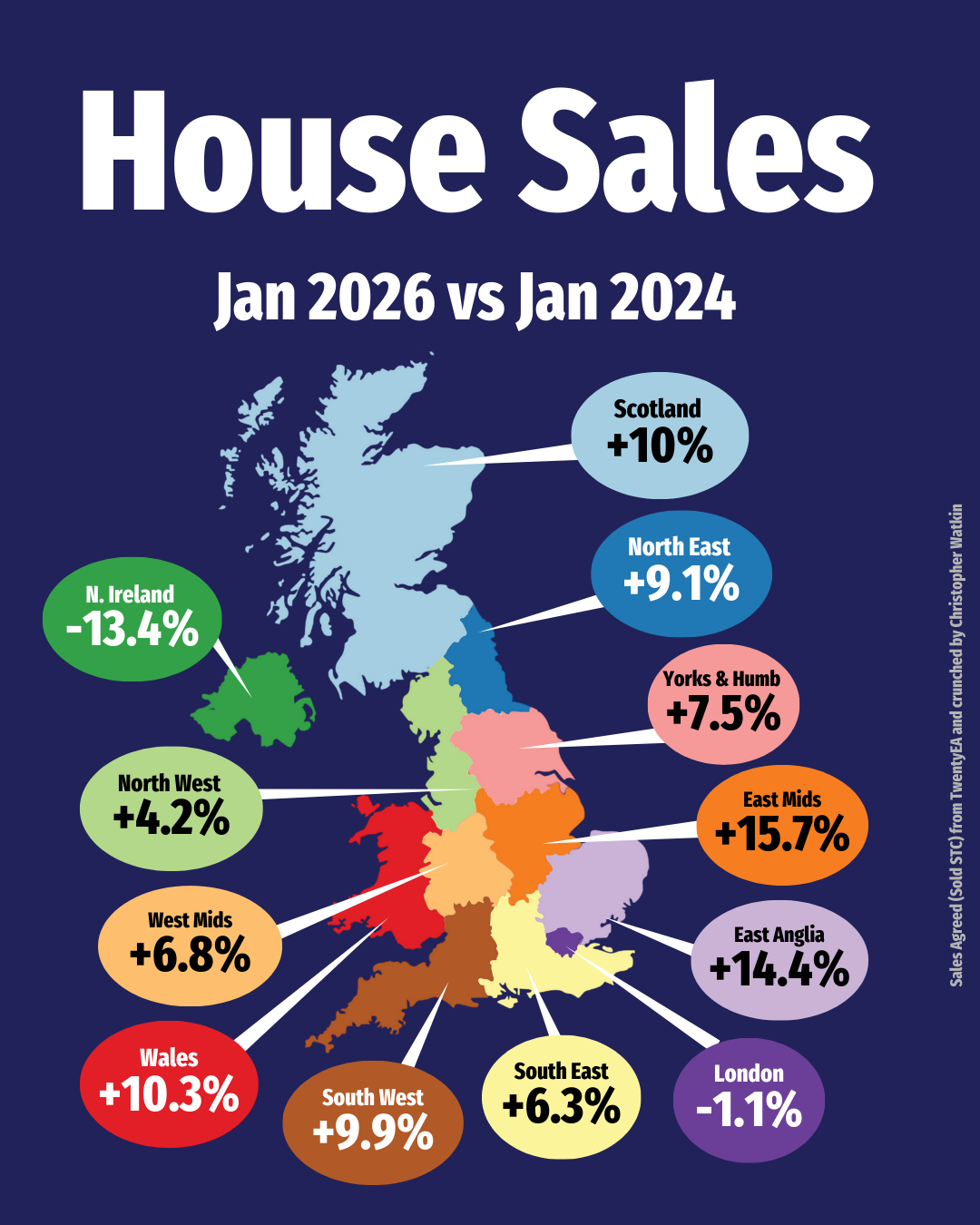
The Midlands and East of England have emerged as the standout performers, with the East Midlands experiencing a significant 15.7% increase in sales agreed, closely followed by East Anglia at 14.4%. These substantial gains are not mere statistical anomalies but rather indicative of strong underlying demand in regions where affordability remains relatively balanced, and lifestyle moves continue to make sense. For instance, research by the UK’s Office for National Statistics highlights the importance of affordability in driving housing market trends.
Other regions, such as Scotland, Wales, and the South West, have also posted notable increases, with 10%, 10.3%, and 9.9% growth, respectively. Even areas often characterized as slower or more price-sensitive, like the North West and West Midlands, are exhibiting growth rates of 4.2% and 6.8%, underscoring the breadth of the market’s recovery rather than a one-speed phenomenon. This geographic diversity in growth is a positive indicator of the market’s health, as experts at the Royal Institution of Chartered Surveyors often emphasize.
London and the South East: A Different Story
Greater London remains an outlier, with a 1.1% decline in sales agreed, although Outer London saw a 6.9% increase, while Inner London experienced a 6.6% decrease. This disparity is not unexpected, given London’s unique dynamics, including higher prices, stretched affordability, and a complex buyer profile. The South East, while still positive at 6.3%, is also more subdued compared to other parts of the country. According to analyses by property experts, these regional variations are influenced by factors such as commuting patterns, employment opportunities, and the overall cost of living.
The only region moving in the opposite direction is Northern Ireland, with a 13.4% decrease, which can be attributed to local factors rather than a broader UK trend. This highlights the importance of considering regional specifics when assessing the housing market, as studies by the National Association of Estate Agents have shown.
A Market Rebuilding Momentum
The key takeaway from the January 2026 data is that the UK housing market is quietly gathering pace, driven by genuine buyer interest rather than artificial stimuli. For sellers who price their properties sensibly, the conditions are far healthier than headlines might suggest. As industry insiders note, this rebuilding of momentum from the ground up is a positive sign for the market’s long-term stability and growth. For more detailed insights and regional breakdowns, Here.

