

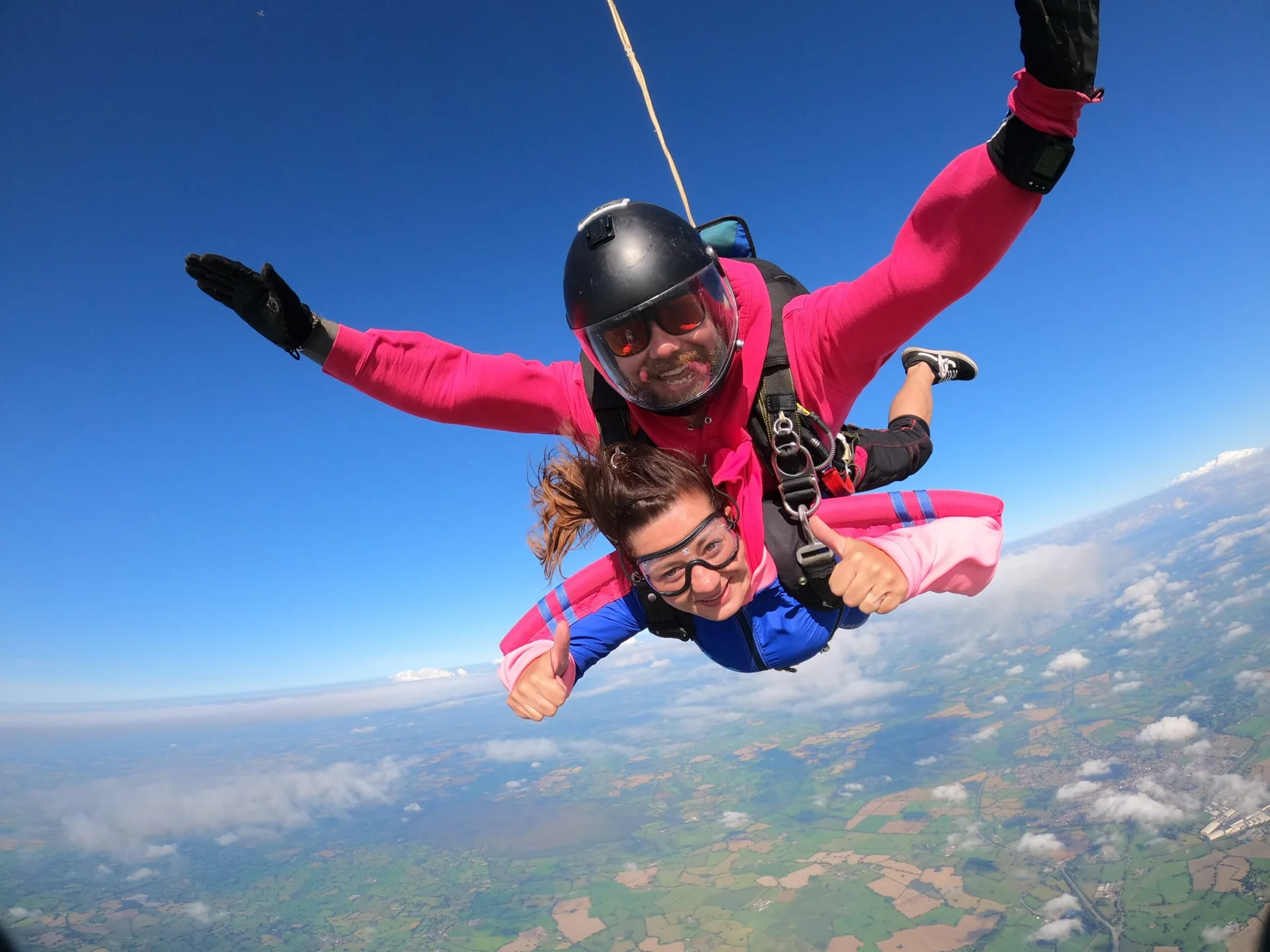
DZONE Skydiving is breaking new ground by becoming the first business to franchise a skydiving operation, demonstrating just how far the franchise model can extend beyond traditional sectors, including the emerging skydiving franchise. This innovative skydiving franchise model is set to transform the industry.
When most people think about franchises, they are likely to picture coffee shops, fast-food restaurants, cleaning companies, gyms or care businesses.
Skydiving probably isn’t high on the list.
Interestingly, the concept of a skydiving franchise is gaining traction and attracting new business owners.
But DZONE Skydiving founder Abbie Mashaal is challenging that assumption by demonstrating that even one of the world’s most specialist and adrenaline-fuelled activities can be developed into a franchise model.
In May 2026, DZONE announced the sale of its first franchise, with long-time employee Eric Skroch taking ownership of the company’s Bozeman-area operation in Three Forks, Montana. The company described the move as the first-ever franchise in the skydiving industry.
The concept of a skydiving franchise opens up new opportunities for entrepreneurs interested in unique and thrilling business ventures. As a skydiving franchise, it stands out from traditional business models.
For the franchise industry, it is an intriguing example of how a successful business can potentially turn a highly specialised operation into a repeatable model.
From part-time business to franchise network
The Rise of the Skydiving Franchise in Today’s Market
Mashaal’s own journey with DZONE began as a passion project.
He launched a skydiving centre in Idaho in 2007 while still working as a computer programmer. What began as a part-time venture eventually became a full-time career as the business grew.
Mashaal subsequently acquired another skydiving centre and eventually brought the operations together under the DZONE brand.
The business has since developed into a specialist operator providing tandem skydiving, flight training and sport jumping.
The company’s move into franchising represents the next stage of that growth strategy.
This expansion into franchising is a significant milestone for the skydiving franchise industry.
Rather than continuing to own every location itself, DZONE is looking to bring entrepreneurial owners into individual territories who can operate their own centres while benefiting from the brand’s systems, technology, marketing and operational experience.
The first skydiving franchise is not just a business; it represents a new frontier in the franchise landscape.
DZONE’s first franchisee was a particularly logical choice.
Eric Skroch had already worked within the DZONE organisation and had extensive experience of the business before becoming an owner.
The deal was signed on May 1, 2026, before being publicly announced during DZONE Bozeman’s annual Safety Day event in Three Forks. (Yahoo Finance)
For Mashaal, choosing someone who already understood the business helped reduce one of the biggest challenges faced by any new franchise system: transferring the practical knowledge required to operate the business successfully.
Skroch had already experienced the customer journey, understood the company’s standards and knew what was required to operate the centre.
That made the transition from employee to franchisee considerably more straightforward.
A franchise investment unlike traditional opportunities
DZONE is certainly not positioned as a low-cost franchise.
The investment required is estimated at approximately $450,000 when purchasing one or two aircraft.
The high investment reflects the unique nature of the skydiving franchise opportunity.
Franchisees that choose to lease aircraft rather than purchase them could potentially reduce the initial investment by around $250,000.
There is also a requirement for an appropriate hangar to store the aircraft.
That puts the opportunity firmly into the category of capital-intensive franchises.
For comparison, many of the UK’s most accessible franchise opportunities require a considerably smaller initial investment and can be operated from relatively modest premises or even from home.
DZONE is a very different proposition.
It combines aviation, tourism, hospitality, specialist equipment, highly trained personnel and a physical location capable of supporting the operation.
However, that complexity could also create a barrier to entry that helps differentiate the business from more conventional franchises.
Why franchise skydiving? The potential for a skydiving franchise can lead to lucrative opportunities for those willing to take the leap.
At first glance, franchising a skydiving centre might seem unusual.
But the underlying principles are remarkably similar to other franchise businesses.
A successful franchise needs a proven concept, recognisable branding, repeatable systems, operational procedures, training and a customer proposition that can be delivered consistently.
DZONE has been working to build those systems around its skydiving operations.
Corporate support includes booking technology and software, while the franchisor also provides marketing and operational expertise.
For a franchise owner, that means they don’t necessarily need to build every part of the business from scratch.
Instead, they can concentrate on managing the local operation, customers and employees while drawing on the wider DZONE infrastructure.
As part of the skydiving franchise, owners can leverage the brand’s reputation to attract customers.
The franchisee doesn’t necessarily need to do the jumping
One of the interesting aspects of the model is that the franchise owner does not necessarily need to be the person jumping from the aircraft.
The operation requires specialist pilots and qualified instructors, allowing the franchise owner to focus on the commercial and managerial side of the business.
That makes the opportunity potentially attractive to someone with strong business skills and an interest in aviation, tourism or adventure experiences, even if they aren’t an experienced skydiver themselves.
For Skroch, however, the business is both a professional opportunity and a personal passion.
He had been involved with skydiving for around a decade before becoming an instructor and carrying out tandem jumps.
He also brought previous business experience to the table, having owned a hot tub retail business for approximately 12 years.
A business built around experience
Unlike many franchise sectors where customers purchase an everyday product or service, skydiving is fundamentally about the experience.
That can provide an interesting marketing advantage.
People don’t generally book a tandem skydive because they need one. They book because they want to create a memory, celebrate an occasion, overcome a fear or experience something completely different.
That opens up a range of potential customer markets, from tourists and adventure seekers to birthday celebrations, corporate events and people looking for an unusual gift experience.
The challenge is ensuring there is enough local and regional demand to keep the operation commercially viable.
Location is therefore likely to be a major consideration for any future DZONE franchisee.
Capacity and revenue potential
DZONE’s Montana operation has capacity for around 100 skydives per week, although its current volumes are closer to 70 jumps per week.
The centre operates up to four days a week, with approximately 25 jumps per day.
A standard tandem jump is priced at around $379.
At 70 jumps a week, that represents significant headline customer revenue before accounting for aircraft costs, staffing, insurance, premises, maintenance, marketing and other operating expenses.
There is also potential to increase volumes as demand grows, although eventually additional infrastructure would be required.
That demonstrates an important principle for franchise investors: revenue potential is only one part of the equation.
In a capital-intensive operation such as skydiving, understanding the underlying cost base and operational capacity is critical.
Safety is at the heart of the business
Naturally, safety is one of the most important elements of the DZONE model.
DZONE emphasizes safety, ensuring that every skydiving franchise adheres to strict regulations and industry standards.
DZONE also carries out background checks and places significant emphasis on recruiting people who can be trusted with the responsibility of taking customers into the air.
Mashaal has stressed that skydiving operators are effectively taking responsibility for people’s lives.
That makes consistency particularly important as the franchise network expands.
For DZONE, franchising therefore cannot simply be about putting the logo above another skydiving centre.
The systems, training, recruitment and safety standards need to be replicated alongside the brand.
The challenge of building a franchise network
One of the biggest questions for DZONE will now be whether its first franchise can become the foundation for a much larger network.
The growth of the skydiving franchise model could redefine expectations in the franchise world.
The company’s first franchisee already knew the business extremely well.
Future franchisees may not have the same level of experience.
That means DZONE will need to demonstrate that its systems and training are sufficiently robust to support owners who are new to the organisation and potentially new to the skydiving industry.
It is a challenge faced by virtually every franchisor.
A business may be highly successful when operated directly by its founder, but franchising requires that success to be transferred to independent business owners.
That is where processes, training, support and franchisee selection become crucial.
DZONE believes the model can go much further
DZONE has made no secret of its ambition to expand its skydiving franchise network across various regions.
Following the launch of the first franchise, Mashaal spoke about the possibility of eventually developing a network of as many as 200 skydiving centres.
Whether the business reaches anything close to that number remains to be seen, but the ambition demonstrates that DZONE views franchising as considerably more than a one-off experiment. (Three Forks Voice)
The brand is now actively looking for additional franchise partners across the United States. (Yahoo Finance)
A lesson for other franchise businesses
Perhaps the most interesting aspect of DZONE’s story isn’t actually the skydiving.
It is what the business demonstrates about franchising.
Entrepreneurs sometimes assume that their business is too specialist, too unusual or too complicated to franchise.
DZONE provides an example of a business operating in an extremely specialised sector that believes its model can be systemised, replicated and operated by independent franchise owners.
The lesson for other business owners is that almost any concept could potentially become a franchise if the right foundations are in place.
A strong brand, proven demand, reliable systems, documented processes, training and ongoing franchisee support are arguably more important than whether the business happens to sell burgers, provide care services — or throw people out of aeroplanes.
The skydiving franchise concept proves that innovative ideas can be successfully franchised.
Could we see more unusual franchises?
The franchise industry has already expanded well beyond traditional retail and food concepts.
Today, franchise opportunities can be found across sectors including healthcare, education, property, technology, professional services, fitness, automotive and specialist home services.
DZONE takes that diversification to another level.
Its emergence as a skydiving franchise raises an interesting question for entrepreneurs across the industry:
If skydiving can be franchised, what other businesses could be next?
This approach to franchising could inspire other unique businesses to consider becoming a franchise.
As franchising continues to evolve, the answer may be almost anything.
For franchise investors looking for something different, the skydiving franchise opportunity may represent a unique investment avenue.
And for business owners considering franchising their own concept, DZONE offers a powerful reminder that being unusual doesn’t necessarily mean being unfranchisable.
Sometimes, the more distinctive the proposition, the greater the opportunity to stand out.
DZONE’s first franchise may therefore represent more than just a new ownership model for skydiving.
It could be another sign that the franchise industry is continuing to expand into areas that would have seemed impossible to franchise only a few years ago.
The development of the skydiving franchise signifies a new chapter in franchise evolution.
Get more of the latest franchise news, trends and opportunities with Franchise Industry New ‘Inbox Edition”.

